
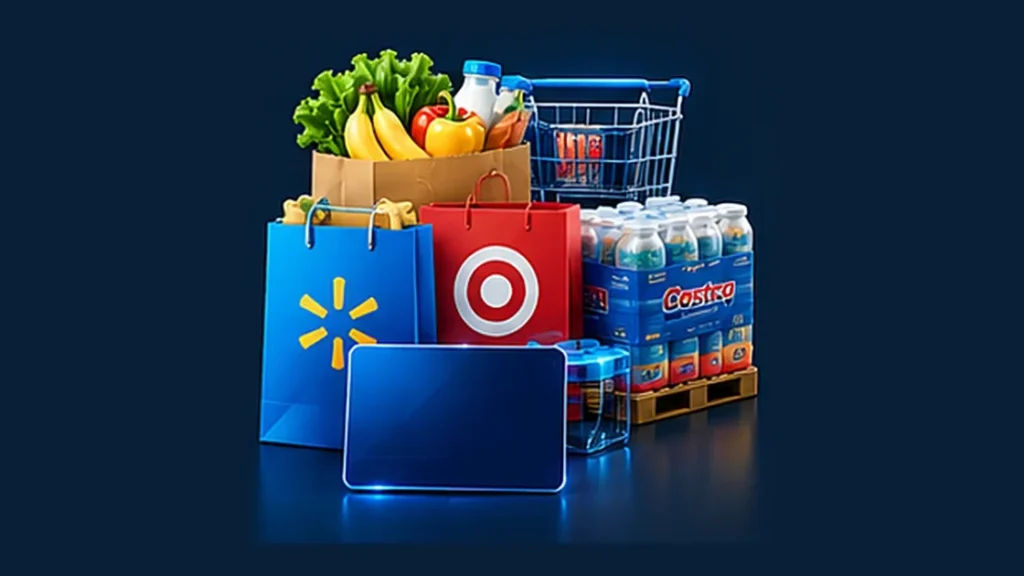
Plenty of cards advertise a high rate “at grocery stores” or “at US supermarkets”. Very few shoppers realize that the three places Americans most often buy food, Walmart, Target and Costco, are usually excluded from exactly those categories. This page explains why, which cards exclude what, and how to check before you assume a rate applies.
Why a store’s name does not decide the rate
Your card issuer does not see a shopping list. It sees a transaction tagged with a merchant category code, a four-digit number assigned by the payment networks that describes what kind of business the merchant is. Grocery stores and supermarkets have their own code. Discount stores, warehouse clubs and general merchandise retailers have different ones.
That is the whole mechanism. A card paying 6% “at US supermarkets” pays 6% on transactions carrying the supermarket code and 1% on everything else, including a cart full of food bought somewhere classified as a discount store. The issuer is not being evasive; it is applying a category the retailer itself sits in.
The three big exclusions, issuer by issuer
American Express defines its US supermarket category explicitly to exclude superstores, convenience stores, warehouse clubs and meal-kit delivery services. In practice that rules out Walmart, Target, Costco, Sam’s Club and BJ’s. This applies to the Blue Cash Preferred’s 6% rate, the Blue Cash Everyday’s 3% rate and the Amex Gold’s 4 points per dollar.
Capital One excludes superstores such as Walmart and Target from its grocery category on cards like the Savor. Warehouse clubs generally do not code as grocery stores either.
Chase pays its Sapphire Preferred 3x rate on online grocery purchases but excludes Target, Walmart and wholesale clubs by name.
Citi pays 3 points per dollar at supermarkets on the Strata Premier; superstores and clubs sit outside that definition.
There are edge cases. Some Walmart and Target locations with full grocery departments have historically coded as grocery stores, and a few Super Target stores have been reported to do so. These are exceptions, they vary by location, and they can change without any announcement. Planning around them is not a strategy.
How to check your own stores in five minutes
Do not guess, and do not trust a forum post from two years ago. Two reliable methods:
- Look at a past statement. Find a purchase at the store in question and check what rate it earned. Most issuers show the rewards earned per transaction in online banking or the app. If a $100 purchase earned $1, it did not qualify for the bonus rate.
- Make a small test purchase at a store you are unsure about and check the rewards on it once it posts. A $5 transaction answers the question definitively for that specific location.
Both methods beat any list, including this one, because coding is set per merchant location and changes without notice.
What to use at each of the three
Costco. Two constraints apply at once: Costco only accepts Visa in its warehouses, and Costco purchases do not earn supermarket bonuses. The Costco Anywhere Visa from Citi is the card built for this, it pays 2% on Costco and Costco.com purchases, 4% on eligible gas including Costco fuel up to an annual cap, 3% on restaurants and eligible travel, and 1% elsewhere. It requires an active Costco membership, and rewards arrive once a year as a certificate rather than as statement credit, which is a meaningful difference if you want cash monthly. Our Costco card guide works through the alternatives, including using a flat 2% Visa instead.
Walmart and Target. Both run their own store-branded cards with higher rates inside their own ecosystems, and both have changed issuing partners over the years, so confirm who issues the current product and on what terms before applying. The general-purpose answer is simpler: because neither qualifies for a supermarket bonus on mainstream cards, the best rate available is usually whatever your flat-rate card pays. A no-annual-fee 2% card earns 2% at Walmart, at Target, at Costco and everywhere else, with no category definitions to read.
That is the quiet conclusion of this whole topic: for superstore and warehouse shoppers, a flat 2% card is frequently the highest-paying option, and the 6% headline that looks so much better is simply unavailable to them.
What common cards actually pay at the big three
| Card | Walmart and Target | Costco warehouse |
|---|---|---|
| Amex Blue Cash Preferred or Everyday | 1% | Not accepted |
| Amex Gold | 1x | Not accepted |
| Capital One Savor (Mastercard) | 1% | Not accepted |
| Chase Sapphire Preferred (Visa) | 1x | 1x |
| Costco Anywhere Visa | 1% | 2% |
| Bank of America Customized Cash (Visa) | 1% unless your chosen 3% category applies | 2%, within the $2,500 quarterly cap |
| Wells Fargo Active Cash (Visa) | 2% | 2% |
Read down the last column and the pattern is plain: at the places most families actually buy food, the cards with the biggest grocery headlines pay the least, and a plain 2% Visa pays the most.
The cap, which bites even when the coding works
Suppose your stores do code as supermarkets. The high rates still come with ceilings:
- Amex Blue Cash Preferred: 6% on the first $6,000 of US supermarket spending each year, then 1%. Maximum from that bucket: $360, against a $95 annual fee after the first year.
- Amex Blue Cash Everyday: 3% on the first $6,000 a year, then 1%. Maximum: $180, no annual fee.
- Amex Gold: 4 points per dollar on the first $25,000 a year, a much higher ceiling, on a card with a $325 fee.
- Bank of America Customized Cash Rewards: 2% at grocery stores and wholesale clubs on the first $2,500 of combined spending per quarter. Notably, this is one of the few mainstream cards whose category explicitly includes wholesale clubs.
A household spending $800 a month on food exhausts a $6,000 annual cap in the middle of August. From then until January the 6% card pays 1%, worse than a flat 2% card. The practical move is to switch cards once the cap is reached, which requires knowing where you stand. Most issuers do not warn you.
Gift cards: the legitimate workaround, and its limits
Grocery stores sell gift cards for other retailers, and a gift card bought at a supermarket normally earns the supermarket rate. Buying a Walmart or Target gift card at a qualifying supermarket is a recognized way to earn a bonus rate on spending that would otherwise earn 1%.
Three caveats. Issuer terms sometimes exclude gift card purchases from bonus categories, and those terms can be enforced retroactively. Gift cards carry their own risk, lost value, no fraud protection comparable to a card, no return rights. And large or repeated purchases of cash-equivalent products can attract an issuer’s attention. It works, it is legal, and it is not worth building a large habit around.
The bottom line on superstores
The retailer’s category code, not its product range, decides what your card pays. Walmart, Target, Costco, Sam’s Club and BJ’s are excluded from the supermarket categories on every major issuer’s rewards cards, with rare location-specific exceptions. If those are where you shop, a flat 2% card will usually pay you more than any 6% supermarket card, and the Bank of America Customized Cash is one of the few that explicitly includes wholesale clubs, as its category and exclusions page sets out. If you shop at a traditional supermarket, check the cap as well as the rate, the ceiling arrives sooner than most people expect.
For the full comparison of grocery cards see our grocery round-up, the Amex Gold vs Blue Cash Preferred head-to-head, and the cash back picks for the flat-rate options.
Category definitions, caps, fees and merchant coding all change without notice, and coding varies by individual store location. Confirm with your issuer, and check a real transaction, before relying on any rate above.
Where these numbers come from: Costco Anywhere Visa Card (Citi); What credit cards does Costco accept? (Citi). Rates and credits change, so check the live terms before you apply.