
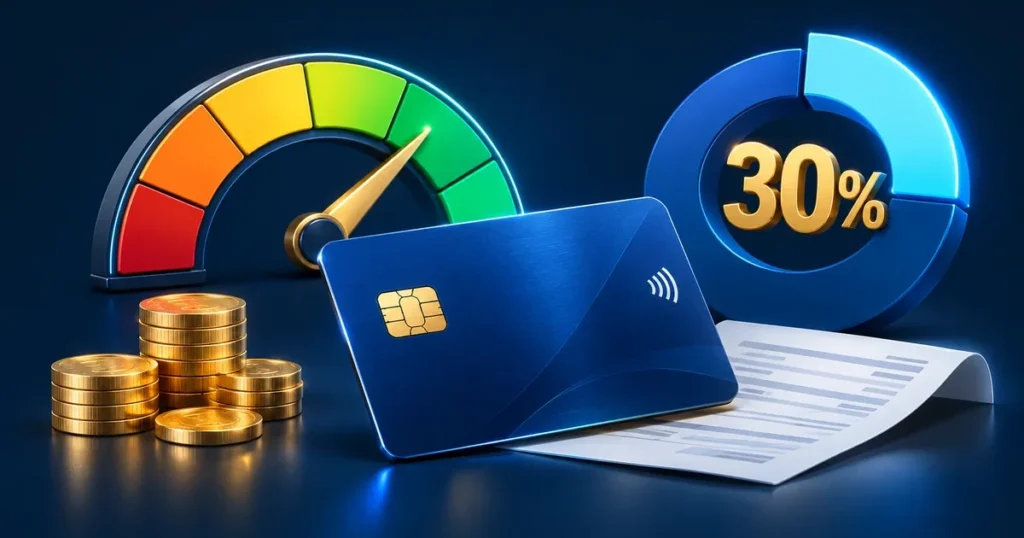
After paying on time, credit utilization is the biggest thing moving your credit score, and it is the one you can change fastest, sometimes inside a single billing cycle. Yet most of what gets repeated about it (“keep it under 30%”) is a rough guideline dressed up as a hard law, and it hides how the number is actually calculated and reported. Below is how utilization really works, why the 30% figure misleads, and how to move it. For the separate question of when a balance starts costing you money, see how credit card interest actually works.
The short answer
Utilization is how much of your available credit you are using, as a percentage: and lower is almost always better. There is no reward for carrying a balance.
The “30% rule” is a myth as a target. 30% is a ceiling you want to stay under, not a number to aim for. Single digits score best.
Two numbers count: your overall utilization and your highest single card. One maxed-out card can hurt even when your overall looks fine.
The lever most people miss: issuers report your statement balance, so paying down before the statement closes, not just before the due date, is what actually moves the number.
What credit utilization actually is
Credit utilization is simply your balance divided by your credit limit, written as a percentage. Put $300 on a card with a $1,000 limit and your utilization on that card is 30%. It only applies to revolving accounts (credit cards and lines of credit), not to installment loans like a car loan or mortgage, where owing most of the balance is normal and expected.
It matters because it sits inside the “amounts owed” part of your FICO score, which is worth roughly 30% of the total, second only to payment history. That is a large share of your score riding on a number you can change in days. See FICO’s own breakdown of the amounts owed category for the official weighting.
Why the “30% rule” is a myth
The 30% figure is real in one narrow sense: crossing it is where the damage to your score tends to speed up. But somewhere along the way “don’t go above 30%” got flipped into “30% is the target,” and that is wrong. There is no hard cliff. Utilization works as a continuous slope: lower is better essentially all the way down, and people at the top of the score range typically sit in the low single digits, not at 30%.
So treat 30% as a line you do not want to cross, not a goal to hit. Sitting at 28% because you think that is “good” leaves real points on the table compared with sitting at 4%.
Per-card and overall: both numbers count
Scoring models look at two things at once: your aggregate utilization (all balances added up, divided by all limits added up) and the utilization on your individual cards. This is where a healthy overall number can mislead, it can hide one card that is maxed out, and that single card can still drag your score down.
| Card | Balance | Limit | Utilization |
|---|---|---|---|
| Card A | $2,700 | $3,000 | 90% |
| Card B | $0 | $5,000 | 0% |
| Card C | $0 | $2,000 | 0% |
| Overall | $2,700 | $10,000 | 27% |
In this example the overall number is a comfortable 27%, but Card A at 90% is still a red flag to the scoring model. Spreading that balance across the other cards, or paying it down, would help even though the overall figure barely changes. (Illustrative figures to show the mechanism, not a recommendation.)
The timing trick most people get wrong
This is the part that catches out even careful payers. Your issuer reports your balance to the credit bureaus once a month, and the balance it reports is usually your statement (closing) balance, not whatever you owe on the due date. So you can pay your bill in full every month, never touch interest, and still have high utilization reported, because a big balance was sitting on the statement when it closed.
The fix is to pay down the card before the statement closing date, or make a mid-cycle payment, so that a low balance is what gets reported. Paying in full by the due date protects you from interest (that is the grace period); paying before the statement closes protects your utilization. They are two different dates doing two different jobs.
How to lower utilization fast
Because utilization is based on your most recently reported balances, it responds quickly. If you have a mortgage or card application coming up, these move the number within a cycle:
Pay before the statement closes. The single most effective trick, it changes the balance that actually gets reported.
Ask for a credit limit increase. Raising your limit lowers utilization even if your balance stays the same, because it grows the denominator. Check first whether your issuer does a hard inquiry for increases.
Do not close unused cards right before applying. Closing a card removes its limit from your total available credit, which can spike your utilization overnight. If you are thinking about it, read how to cancel or downgrade a card without hurting your score first.
Pay twice a month. A mid-cycle payment keeps the reported balance down without you having to track the exact statement date.
Does utilization have a memory?
Mostly no, and that is the good news. For FICO, utilization is a snapshot, not a history: it is calculated from your most recently reported balances, so a high month does not follow you around. Pay the balance down and your score recovers as soon as the lower number reports, usually the next cycle, which is what makes it the quickest number to move on your whole credit report. One caveat: some newer models, such as VantageScore 4.0, also look at your balance trend over time, so a long habit of low balances helps there; payment history, by contrast, can hold a single late payment for years. If you are still building your file, our guides to the best cards for building credit and secured cards for bad credit cover where to start.
Frequently asked questions
What is the ideal credit utilization? Low single digits, roughly 1% to 9%, tend to score best. Reporting 0% on everything can very slightly underperform a few percent, because it shows no active use, but the difference is tiny and not worth obsessing over.
Does carrying a balance help my score? No. This is one of the most persistent myths in credit. Paying in full is best for both your score and your wallet; carrying a balance just hands the issuer interest for nothing. See how interest works.
I paid my card in full but my utilization still looks high: why? Because the balance that gets reported is the one on your statement closing date, not what you owe after you pay. Pay down before the statement closes, not just before the due date, and the reported number drops.
Do all scoring models treat it the same? They weigh it a little differently (FICO and VantageScore are not identical), but low utilization helps your score in every mainstream model. You do not need to optimize for one.
The bottom line
Three habits separate a good utilization number from a great one: aim for low single digits instead of treating 30% as a pass, watch your highest single card and not just the overall figure, and pay down before the statement closes rather than only before the due date. None of it requires carrying a balance or paying a cent of interest, just better timing. For how much score you need in the first place, see what credit score you need for a credit card, or read the US Consumer Financial Protection Bureau’s plain-English take on credit utilization rate.
How credit card interest actually works · What credit score you need for a credit card · Cancel or downgrade a card without hurting your score · Best cards for building credit