
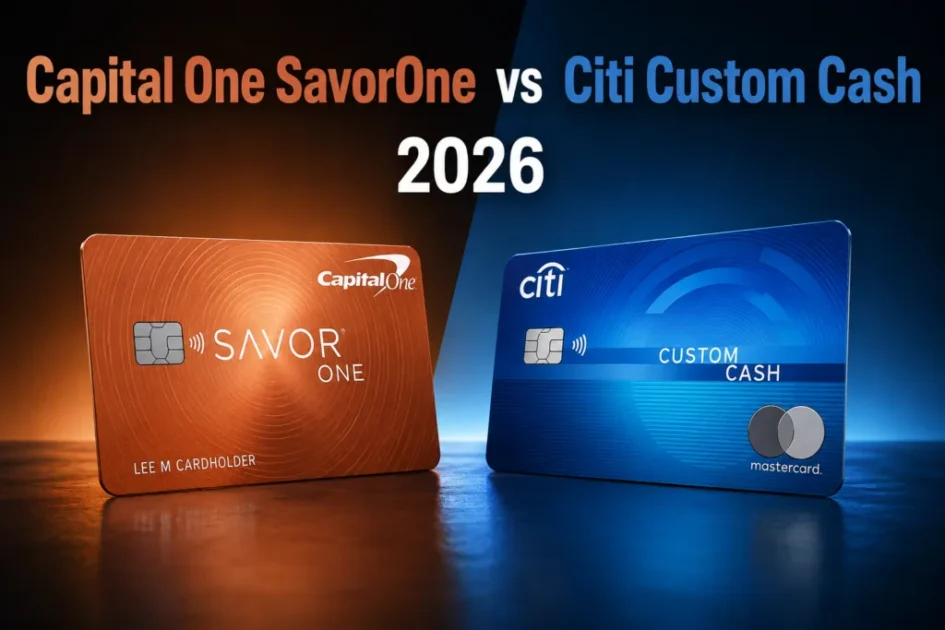
Until this year this was a close call between two no-annual-fee cards that both paid well on restaurants. In 2026 it stopped being a fair fight, because one of the two is no longer available to new applicants.
The short answer
Applying today: it is the Capital One Savor. The Custom Cash stopped taking new applications on May 28, 2026, so it is off the menu. The Savor pays a flat 3% on dining, entertainment, groceries and streaming, with no cap.
Already hold the Custom Cash: keep it. There is no fee, it preserves your account age, and it still pays best if your top category stays under about $500 a month.
Hold both? Let the Custom Cash cover your single biggest category and the Savor handle everything else at 3%.
The update that changes this comparison
Citi stopped accepting new applications for the Citi Custom Cash Card on May 28, 2026. The card was not canceled: people who already hold one keep it, keep the 5% structure and keep earning, and Citi has not announced an end date for existing accounts. But if you are reading this while deciding which card to apply for, the Custom Cash is not on the menu. Reports from cardholders suggest Citi has still been processing product changes into the Custom Cash for people who already hold another Citi card, although Citi has published no policy on this, so treat it as something to ask Citi about rather than something to count on.
That leaves the comparison useful for two groups: people who already hold the Custom Cash and want to know whether to keep it, and people choosing a dining card today who want to understand what the Custom Cash was good at, so they can judge what replaces it.
Where each no-fee option pays, October 2026
| Capital One Savor | Citi Custom Cash | Chase Freedom Flex | Amex Blue Cash Preferred | |
|---|---|---|---|---|
| Open to new applicants | Yes | No, since May 28, 2026 | Yes | Yes |
| Annual fee | $0 | $0 | $0 | $0 first year, then $95 |
| Restaurants | 3% | 5% if it is your top category | 3% | 1% |
| Grocery stores | 3% | 5% if it is your top category | 5% only in quarters when it is a bonus category | 6% at US supermarkets |
| Streaming | 3% | 5% if it is your top category | Only in bonus quarters | 6% on select US services |
| Cap on the bonus rate | None | $500 per billing cycle | $1,500 per quarter | $6,000 a year at supermarkets |
| Foreign transaction fee | None | 3% | None since September 22, 2026 | 2.7% |
What each card actually pays
Capital One Savor (the card previously sold as SavorOne), no annual fee, no foreign transaction fee:
- 3% back on dining, entertainment, popular streaming services and at grocery stores
- 8% back on tickets bought through Capital One Entertainment
- 5% back on hotels and rental cars booked through Capital One Travel
- 1% on everything else
Citi Custom Cash: no annual fee:
- 5% back in your single highest-spend eligible category each billing cycle, on the first $500 of that category’s spend, then 1%
- 1% on everything else
- An extra 4% on hotels, car rentals and attractions booked through the Citi Travel portal
The Custom Cash never needed activating and never needed choosing: it looked at where you spent most that cycle and paid 5% there. That was its appeal, and also its limit.
The $500 cap is the whole comparison
5% of $500 is $25. That is the absolute ceiling on what the Custom Cash’s headline rate can pay in a billing cycle, $300 a year, no matter how much you spend. Everything above $500 in that category drops to 1%, the same rate the card pays on gas, pharmacies and everything else.
The Savor has no category cap at all, but pays 3% instead of 5%. So the arithmetic is simple: 3% of your whole eligible spend versus 5% of the first $500 plus 1% of the rest.
Spread-out spending favors the Savor. Take $400 a month on restaurants, $500 at the supermarket and $40 on streaming, $940 of category spend. The Savor pays 3% on all of it: about $28 a month. The Custom Cash picks groceries as the top category, pays 5% on $500 ($25), then 1% on the remaining $440 ($4.40): about $29 a month. Essentially a tie, and the Savor pulls ahead the moment either figure grows.
Concentrated spending favoured the Custom Cash. Someone who spends $450 a month on restaurants and little else in a bonus category earned $22.50 from the Custom Cash versus $13.50 from the Savor. The Custom Cash was a specialist for one modest, concentrated habit.
Heavy spending in one category favors neither. At $1,200 a month on restaurants the Custom Cash pays $25 + $7 = $32; the Savor pays $36; a card such as the Amex Gold at 4 points per dollar on restaurants is in a different league again, but it carries a $325 annual fee that has to be covered first.
If you already hold the Custom Cash
There is no published reason to close it. It has no annual fee, so it costs nothing to keep, and keeping it preserves the account’s age, which is part of how credit scoring models look at your file. If your spending is concentrated, it may still be your best-paying card on that category.
What changes is planning: you cannot add a second one, and you cannot assume a replacement will be offered on the same terms. If the 5% bucket matters to your monthly math, it is worth knowing now which card you would move that spending to.
How we compared them
- Monthly scenarios instead of headline rates. A 5% card with a $500 cap and a 3% card with no cap only separate once you put real spending through them, so we ran spread-out, concentrated and heavy single-category households.
- Issuer category definitions. Capital One excludes superstores from its grocery rate, and Citi’s cap runs per billing cycle, not per calendar month; both change the result.
- Cash back at face value: no point valuations are needed for either card.
- Availability checked. The Custom Cash closed to new applications on May 28, 2026, so we treat it as a keep-or-close decision rather than an option to apply for. Neither issuer pays CardRankr, and we earn nothing if you apply.
If you are applying today
The Savor is the direct, still-available answer for a no-annual-fee card that pays on dining, groceries and streaming at once. Two other structures are worth weighing against it:
- Amex Blue Cash Preferred: 6% at US supermarkets on the first $6,000 a year (1% after that), 6% on select US streaming, 3% at US gas stations and on transit. No annual fee the first year, then $95. The 6% rate is the highest here, but it only applies to supermarkets, and the $6,000 cap is annual, not monthly.
- Chase Freedom Flex: 5% on rotating quarterly categories, on up to $1,500 of combined spend per quarter, with activation required each quarter, plus 3% on dining and drugstores year-round. More to manage, a higher quarterly ceiling than the Custom Cash offered, and the categories are not yours to choose.
Our round-ups go deeper on both: see best credit cards for dining, groceries and cash back generally, plus the head-to-head on Amex Gold vs Blue Cash Preferred.
Watch out
The Custom Cash picks your single highest-spend eligible category automatically each billing cycle. A big one-off purchase in another eligible category can grab the 5% for that month and leave your usual spending at 1%. It rewards steady spending in one place, not a lumpy month.
Details that are easy to miss
- Capital One’s “grocery stores” is narrower than it sounds. Superstores such as Walmart and Target are excluded, and warehouse clubs generally do not code as grocery stores either. If that is where you buy food, the 3% may not apply.
- The Custom Cash cap is per billing cycle, not per calendar month. If your statement closes mid-month, a holiday-season splurge can straddle two cycles, occasionally in your favor.
- Application rules differ. Citi has generally limited applicants to one card every eight days and two every 65 days. Capital One typically approves one new card every six months. Neither is published as a formal rule, and both issuers apply their own judgment.
- Streaming definitions vary by issuer and are revised without notice. A service that earned 3% last year may not this year.
Other questions worth answering
Can I still get the Citi Custom Cash?
Not as a new applicant: Citi stopped taking applications on May 28, 2026. Existing cardholders keep the card and its 5% structure. Some people who already hold another Citi card report being offered a product change into it, but Citi has not published that as a policy, so ask rather than assume.
Is the Capital One Savor the same card as the SavorOne?
Yes. Capital One renamed the no-annual-fee SavorOne as the Savor, keeping the 3% categories and the $0 fee. The older Savor that carried an annual fee is no longer offered to new applicants.
Does the Savor pay 3% at Walmart, Target or Costco?
Generally no. Capital One excludes superstores such as Walmart and Target from its grocery category, and warehouse clubs do not usually code as grocery stores. See the best cards for Walmart, Target and Costco if that is where you shop.
Can I use either card abroad without fees?
Only the Savor. It charges no foreign transaction fee, while the Custom Cash adds 3% to every purchase made abroad or with a foreign merchant.
Keep it, or switch to the Savor
For a new applicant in October 2026 there is no choice to make: the Custom Cash is closed and the Savor is the card you can actually get. For an existing Custom Cash holder, the card still does one job well, 5% on up to $500 a cycle in whichever category you happen to spend most, and it costs nothing to keep doing it. The honest summary is that the Custom Cash was the better card for a narrow spender and the Savor is the better card for most households, and availability has now settled the argument for everyone else.
Which is right for you depends on your own spending, and the figures above are published terms as of October 2026, not promises. Check the issuer’s current terms before you apply.
Where the figures come from
- Savor Rewards: card terms — Capital One
- Citi Custom Cash: card terms — Citi
- Credit card agreement database — Consumer Financial Protection Bureau