
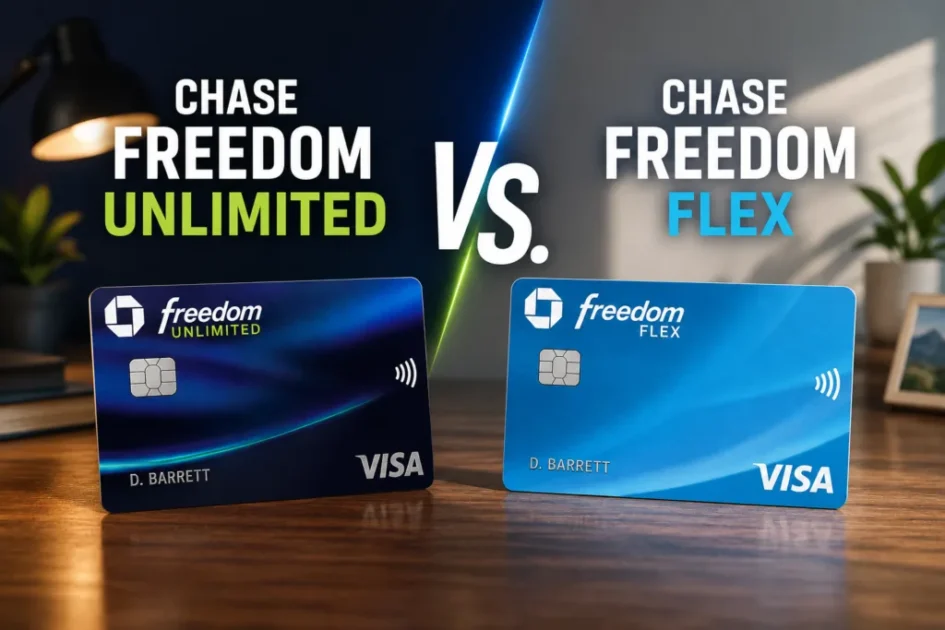
These two cards are more alike than any other pair Chase sells. Both have no annual fee. Both pay 3% on dining and at drugstores and 5% on travel booked through Chase Travel. Both earn Ultimate Rewards points. Until September 21, 2026 both also charged a 3% foreign transaction fee; since then the Flex charges none. Apart from that, everything that usually decides a comparison is identical.
The entire difference is what happens on the spending that falls outside those shared categories:
- Freedom Unlimited: 1.5% on everything else, always, with nothing to remember.
- Freedom Flex: 5% on rotating quarterly categories, on up to $1,500 of combined spending per quarter, with activation required each quarter, and 1% on everything else.
The two cards side by side
| Freedom Unlimited | Freedom Flex | |
|---|---|---|
| Annual fee | $0 | $0 |
| Everything outside the categories | 1.5% | 1% |
| Rotating quarterly categories | None | 5% on up to $1,500 a quarter, activation required |
| Dining | 3% | 3% (7% in Q4 2026, when dining is a bonus category) |
| Drugstores | 3% | 3% |
| Chase Travel bookings | 5% | 5% |
| Foreign transaction fee | 3% | None since September 21, 2026 |
| Cell phone protection | None | None (not listed among the card’s current benefits) |
| Trip cancellation and interruption | Up to $1,500 per traveler, $6,000 per trip | Up to $1,500 per traveler, $6,000 per trip |
| Purchase protection | 120 days, up to $500 per item | 120 days, up to $500 per item |
| 0% intro APR | 15 months on purchases and balance transfers | 15 months on purchases and balance transfers |
| Network | Visa | Mastercard |
The arithmetic, in one go
The Flex gains 3.5 percentage points inside its rotating categories. The Unlimited gains 0.5 percentage points on all your other spending. So:
- The Flex’s maximum possible advantage is 3.5% of $1,500 a quarter, $52.50 a quarter, $210 a year, and only if you max all four quarters.
- The Unlimited’s advantage is half a percent of everything you spend outside the shared categories.
Set them equal and you get the break-even:
- If you max the rotating cap every quarter ($6,000 a year in the 5% categories), the Flex is ahead unless your other spending exceeds about $42,000 a year. For almost everyone, the Flex wins outright.
- If you realistically hit $500 a quarter in the categories ($2,000 a year), the Flex gains $70 and the Unlimited catches up at roughly $14,000 of other annual spending. Now it is a genuine contest.
- If you forget to activate a quarter, that quarter pays 1% instead of 5%, and the Unlimited wins that quarter comfortably.
That last point is not a footnote. The Flex’s whole advantage is conditional on three things happening every quarter: you remember to activate, the category matches where you actually spend, and you have $1,500 of that category’s spending available. Miss any one and the card drops to 1%, a third of what the Unlimited pays on the same purchase.
What the categories actually are right now
For Q4 2026 (October 1 to December 31), Chase’s 5% categories are grocery stores: excluding Walmart and Target, dining, and American Red Cross donations made through the official channel, on up to $1,500 of combined spending.
Two things follow. First, activation closes on December 14, 2026, and Chase applies it retroactively to qualifying purchases already made this quarter, so activating late still rescues the whole quarter. Second, the quarterly bonus is an extra 4% on top of the card’s normal rate, and dining already earns 3% on the Flex, so this quarter the Flex pays 7% at restaurants within the $1,500 cap. Against the Unlimited’s 3%, that is a 4-point uplift on dining and 3.5 points on groceries.
Our quarterly bonus category tracker carries the current lists and deadlines for both Chase and Discover.
Historically the rotations have covered groceries, gas, wholesale clubs, streaming, PayPal, Amazon and similar. They are announced a quarter ahead and they are not yours to choose, which is the structural weakness of every rotating card.
The answer most people should actually take
Neither card charges an annual fee. So the question “which one” has an obvious third answer: hold both.
Used together they cover each other’s weakness exactly. The Flex handles the quarterly 5% categories up to the $1,500 cap; the Unlimited handles everything the Flex would pay 1% on, at 1.5%. The shared 3% dining and drugstore rates apply on whichever you pull out. There is no downside beyond two cards in a wallet and one activation reminder a quarter.
A household spending $2,000 a month with $500 a quarter in the rotating categories earns roughly $70 a year more from the pair than from the Unlimited alone, and roughly $120 a year more than from the Flex alone. The gap widens the more you use the categories.
One constraint on doing it: Chase’s unwritten 5/24 rule means each application counts, and you cannot open both at once, Chase generally limits you to two personal cards in any 30 days, with one every 90 days the safer pace. If you are near the threshold, spend the slot on the card that fits your spending and come back later. See our guide to issuer application rules.
Points: the part that outranks all of this
Both cards earn Ultimate Rewards. On their own, that is cash back at the rates above.
Held alongside a Chase Sapphire card, those points can be transferred to airline and hotel partners, and World of Hyatt in particular often returns well above two cents per Hyatt point, at 1:1 through the Sapphire Reserve or 4:3 through the Sapphire Preferred since 2026. That can add half again to double the real value of everything either card earns, which dwarfs the $70 to $210 the Flex-versus-Unlimited question is worth.
If you are choosing between these two and also considering a Sapphire, decide the Sapphire question first, it is worth more. Our Sapphire Preferred review covers whether that $95 is justified.
Abroad, the Flex now wins
Since September 21, 2026 the Freedom Flex charges no foreign transaction fee, while the Freedom Unlimited still charges 3%. On a $3,000 trip that is $90 on the Unlimited and nothing on the Flex, more than the entire annual earning difference between the two cards.
The same update removed the Flex’s cell phone protection, which used to cover up to $800 per claim when you paid your phone bill with the card. If you relied on it, you will need it from another card now. For the full field of cards without foreign fees, see our no-foreign-fee guide, and the Quicksilver vs Freedom Unlimited comparison for the flat-rate alternative.
How we compared them
Shared categories taken out. Dining, drugstores and Chase Travel pay the same on both, so the comparison isolates the Unlimited’s extra half point against the Flex’s rotating 5%. Three realistic Flex users: one who maxes every quarter, one who manages $500 a quarter, and one who forgets to activate, because the card’s value depends on behavior, not on the headline rate. Current quarter from Chase’s own card page, including the way the bonus stacks on dining to 7%. The September 21, 2026 update dropped the Flex’s foreign transaction fee, and cell phone protection no longer appears among its benefits. Chase does not pay CardRankr, and we earn nothing if you apply.
Which to choose
Choose the Freedom Flex if you will genuinely activate each quarter and the categories tend to match your spending, groceries and gas rotations in particular are easy to max. It is also now the one to take abroad, with no foreign transaction fee. The ceiling is $210 a year of extra value for about two minutes of admin per quarter.
Choose the Freedom Unlimited if you know yourself well enough to admit you will not activate, if your spending is spread thin across things that never appear in a rotation, or if you simply want one card you never think about. 1.5% with no conditions beats 5% you keep forgetting to claim.
Choose both if Chase will approve you for both over time. It is the highest-earning answer and it costs nothing.
Choose neither if your spending is flat and uncategorized: a no-annual-fee 2% card pays more than the Unlimited’s base rate and asks even less of you. See our cash back round-up.
Questions readers ask us
Does the Freedom Flex charge a foreign transaction fee?
Not any more. Chase removed it on September 21, 2026, so the Flex can now be used abroad at no extra cost. The Freedom Unlimited still adds 3% to purchases made abroad or with foreign merchants.
Does the Freedom Flex still include cell phone protection?
No. It no longer appears among the card’s benefits on Chase’s card page (checked October 2026). It used to cover theft or damage up to $800 per claim, with a $50 deductible, when you paid your monthly phone bill with the card.
Why does the Flex pay 7% on dining this quarter?
Chase’s quarterly bonus is an extra 4% added to the card’s normal rate. Dining already earns 3% on the Flex, so in Q4 2026 it earns 7% until combined bonus spending on groceries, dining and Red Cross donations reaches $1,500. Activate by December 14, 2026; it applies back to October 1.
Can I get both cards?
Yes, but not on the same day. Chase generally approves no more than two personal cards in 30 days and declines most applicants who have opened five or more cards in 24 months, so space the applications out. Our guide to application rules has the detail.
Bottom line
These are the same card with two differences. Since September 2026 the Flex charges no foreign transaction fee, and it trades half a point on everything for 3.5 points on a capped, rotating, activation-dependent slice of your spending. If you will do the admin, that trade is worth up to $210 a year. If you will not, it costs you money.
And since neither charges a fee, the honest recommendation for most people is not to choose at all, hold both, let the Flex take the quarterly categories and the Unlimited take the rest.
For the related comparisons see Double Cash vs Freedom Unlimited and Discover it vs Freedom Unlimited, and for the no-fee field generally, our no-annual-fee picks.
Bonus categories, caps, activation deadlines, rates and intro offers above are published terms as of October 2026 and change every quarter. Confirm the current quarter’s categories with Chase before relying on them.
Sources and further reading
- Chase Freedom Unlimited: card terms — Chase
- Chase Freedom Flex: card terms and current bonus categories — Chase
- Credit card agreement database — Consumer Financial Protection Bureau