
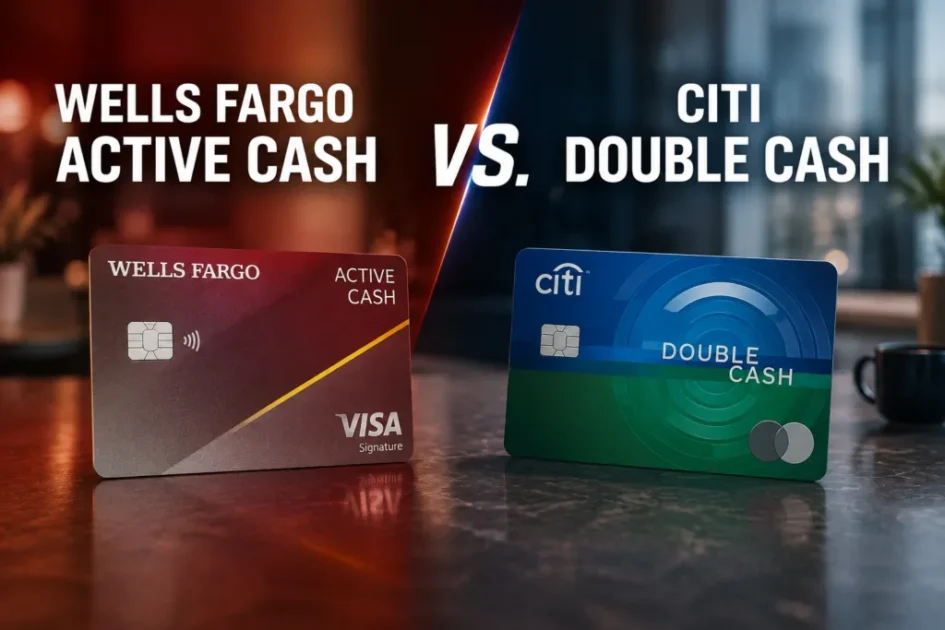
Both of these cards are sold as “2% on everything with no annual fee”, which makes them look interchangeable. One of those 2% rates is unconditional. The other comes with a structure that can quietly pay you less than advertised, and almost nobody explains it before you apply.
Here is how each actually works, the balance transfer detail that costs real money, and which card suits which person.
The asterisk on Citi’s 2%
The Wells Fargo Active Cash pays a flat 2% on purchases, period, regardless of how you redeem it.
The Citi Double Cash pays 1% when you buy and another 1% when you pay the balance. Two consequences follow from that split, and they matter.
First, the second 1% only arrives when you actually pay. Pay the minimum and the rest later, and the second half of your reward arrives later too, the headline rate is really “2% eventually”.
Second, and more concretely: redeeming as a statement credit does not earn the second 1% on the redeemed amount. Using your rewards to reduce your bill reduces what counts as a payment, so that portion never earns its matching 1%. Redeem as a direct deposit or check instead and the problem disappears.
In practice, a disciplined cardholder who pays in full and redeems as cash gets a genuine 2% from either card. Everyone else gets slightly less from the Citi.
Side by side
| Wells Fargo Active Cash | Citi Double Cash | |
|---|---|---|
| Annual fee | $0 | $0 |
| Rewards | 2% flat, unconditional | 1% buying + 1% paying |
| Sign-up bonus | $100 after $500 in 3 months | $200 after $1,500 in 6 months (as 20,000 ThankYou Points) |
| 0% on purchases | 12 months | None |
| 0% on balance transfers | 12 months | 18 months |
| Ongoing APR | 18.74%, 24.74% or 28.74% variable | 18.49%–28.74% variable |
| Standout extra | Cell phone insurance | Points transfer to Citi travel partners |
The balance transfer detail that costs money
The Citi Double Cash has the longer balance transfer offer, 18 months at 0% against Wells Fargo’s 12. If you are moving a balance, that is six extra months of breathing room and it is the stronger card for that job.
But there is a catch worth understanding before you use it: taking the balance transfer offer removes the grace period on new purchases. Normally, paying your statement in full each month means you are never charged interest on purchases. Once you are carrying a transferred balance, that protection goes, new purchases start accruing interest immediately, at the standard APR, even while the transferred balance sits at 0%.
So the correct way to use it is to transfer the balance and then stop using the card until the balance is cleared. Put your everyday spending on a different card. People who treat a balance transfer card as a rewards card at the same time end up paying interest they did not expect, which is why we treat these as two separate jobs in our balance transfer guide.
The Active Cash avoids the question differently: its 12 months of 0% covers both purchases and balance transfers, so if what you need is breathing room on upcoming spending rather than old debt, it is the more straightforward option.
The extras actually decide this one
Since the base rates are so close, the tiebreakers carry more weight than usual.
Cell phone insurance (Active Cash). Pay your monthly phone bill with the card and your handset is covered against damage and theft, subject to the policy’s terms and deductible. If you would otherwise buy phone insurance, this is worth more per year than the entire rate difference between the two cards.
Transferable points (Double Cash). The cash back is really ThankYou Points, and if you hold them alongside an eligible Citi card they can transfer to airline and hotel partners, where they may be worth more than a cent each. If you never intend to do that, this benefit is worth nothing to you and the card is simply a cash back card.
The bonus. Citi pays more ($200 against $100) but asks for three times the spending over twice the window. If $1,500 in six months is normal for you, take the bigger bonus; if it would mean spending you would not otherwise do, it is not a bonus.
Which one?
Take the Active Cash if you want 2% with no conditions and no thinking, if you want phone cover, or if you need 0% on upcoming purchases as well as transfers. It is the simpler card and the simpler 2%.
Take the Double Cash if you are moving an existing balance and want the longest 0% window, or if you already hold a Citi travel card and will use the transfer partners. Just redeem as cash rather than as a statement credit, and do not spend on it while a transferred balance is sitting there.
And if neither extra appeals, note that a flat 2% card is best used as half of a pair rather than alone, our no-annual-fee guide covers the free combination that beats either of these on its own. Neither card is a good choice for travel abroad, incidentally; both charge a foreign transaction fee, so see the travel fee guide before packing one.
Common questions about these two
Is the Citi Double Cash really 2%? Yes, if you pay your balance and redeem as cash rather than as a statement credit. The second 1% is tied to payment, so the rate is conditional in a way the Active Cash’s is not.
Which has the better balance transfer offer? The Double Cash, at 18 months against 12. Remember that taking it removes the grace period on new purchases, so use a different card for spending until the balance is gone.
Does the Active Cash phone insurance cost anything? There is no separate charge, but you must pay your phone bill with the card and a deductible applies per claim. Check the current policy terms, which the issuer can change.
Can I hold both cards? Yes, and there is no fee either way. In practice there is little point, two flat-rate 2% cards do the same job. Pair one with a rotating-category card instead.
Do these cards work abroad? They work, but both add a foreign transaction fee to purchases from foreign merchants, including online. For travel, a no-foreign-fee card will cost you less than either one earns.
How we compared the two
We compared these two cards on published terms, paying particular attention to the conditions attached to each rewards structure, the intro APR coverage, and the effect of the balance transfer offer on the purchase grace period. Figures come from the issuers’ published terms. Neither card’s issuer pays for placement here; CardRankr makes its money from display ads, not affiliate links.
Issuers change rates, bonuses, intro offers and benefits at any time without notice. Everything above reflects the terms published at the time of writing, confirm the current details with the issuer before applying. Last verified: October 2026.
Where to go from here
- Citi Double Cash vs. Chase Freedom Unlimited (2026)
- Best No-Annual-Fee Credit Cards of 2026
- Best Balance Transfer Credit Cards of 2026
- Capital One Quicksilver vs. Chase Freedom Unlimited
- Discover it® Cash Back vs. Chase Freedom Unlimited®
For the full terms behind every figure here, see Citi Double Cash, Do I pay interest on new purchases after a balance transfer? and Credit card agreement database.